3 Kifs par Jour by Florence Servan-Schreiber: My Notes
I have a gratitude practice. Have had one for years – pen on paper every morning before anything else happens, before coffee, before the phone, before I remember what today requires of me.
Ten things I am grateful for. Simple. Small. Why ten? Because three just didn’t feel like enough for me and it forces me to think more. My personal choice, not a requirement at all. And yet I have noticed, without being entirely able to explain why, that the days I skip it feel different. Greyer. More reactive. More like I am being dragged through events rather than choosing them.
Then I read Florence Servan-Schreiber’s 3 Kifs par Jour, the French book about noticing three small moments of joy each day, and understood exactly why.
Table of Contents
Who Is Florence Servan-Schreiber?
Florence Servan-Schreiber is a French journalist and positive psychology researcher who has spent years making the science of happiness accessible to a French-speaking audience that is, let us be honest, somewhat sceptical of anything that sounds too cheerful.
She is warm, precise, and completely devoid of the relentless optimism that makes some happiness books unreadable. She is not asking you to pretend things are fine. She is asking you to notice the things that genuinely are.
What Is a Kif?
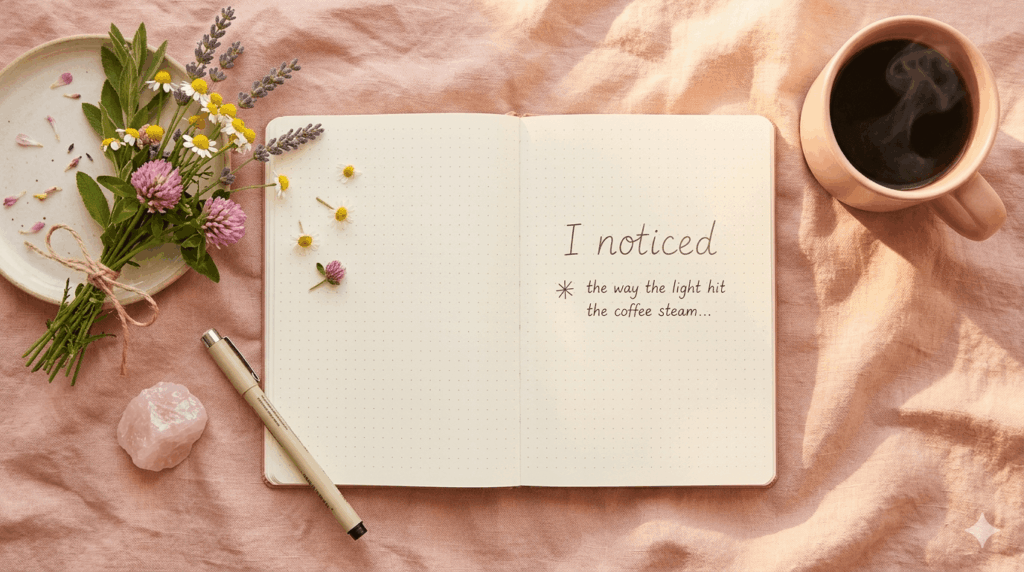
“Kif” is French slang. It means something like bliss, joy, or delight – but specifically the small, sensory, immediate kind. The first sip of a proper coffee. The dog settling against your legs. A slant of morning light through the kitchen window. A song coming on that you forgot you loved.
It is not gratitude in the abstract sense – not “I’m grateful for my health and my family.” It is more specific than that. More physical. More now.
The distinction matters. Abstract gratitude is real and valuable. But Florence Servan-Schreiber’s kif asks you to locate the joy in something you can sense, something present, something that actually landed in your body in the last twenty-four hours. It is the difference between “I appreciate sunshine” and “that patch of warmth on my shoulder while I was reading this morning.”
That specificity is everything.
The Neuroscience of Three Good Things
Here is where it stops being just a nice idea.
Martin Seligman, one of the founders of positive psychology, ran a study on what he called the Three Good Things practice. Participants wrote down three positive things that happened each day for one week. They were tested for happiness and depression levels before, after, and at regular intervals.
The results were striking – not just during the week, but for months afterwards. Participants who kept up the practice showed lasting improvements in mood and reductions in depressive symptoms.
What is happening in the brain is this: we are wired for negativity. Not because we are pessimistic by nature, but because our brains evolved to scan for threats. Left to itself, the mind curates a highlight reel of everything that went wrong, everything that could go wrong, everything that almost went wrong but caught itself just in time.
Three positive experiences a day, noticed deliberately, begins to counteract this. Not by pretending the bad is not there. By training the brain to register the good with equal weight – which it will not do on its own.
Tara Swart writes about exactly this mechanism in The Source – the brain changes through consistently directed attention. The science behind gratitude practices and the science behind manifestation are, it turns out, the same science.
Why Three? Why Every Day?
Three is specific enough to require real attention, and small enough not to become a task. One feels too easy – you could phone it in. Five starts to feel like homework (I love homework so I chose ten back then and now it’s just normal for me). To be honest I have about five that are the same everyday, they just come back naturally, instinctively, the other five, I have to really think about and I like that process!
And every day matters because the brain changes through repetition. Consistent, repeated attention toward the positive literally strengthens the neural pathways that notice good things. Not immediately. But over weeks, something shifts. The positive stops needing to be exceptional to register. Ordinary pleasures become visible again.
The bar for noticing lowers – which sounds like settling, but is actually the opposite. It is accuracy.
What It Changed in My Practice
My morning gratitudes were already ten things. But if I am honest, five were sometimes a little generic. The children. My husband. This house. All true. All real. But occasionally slightly automatic.
Reading Florence Servan-Schreiber sharpened them. Now I try to locate actual kifs – specific moments from the previous day or that morning that genuinely landed. Yesterday: the way the light came in at an angle across the bed during my reading hour and was perfect. My youngest appearing in the doorway not yet quite awake, leaning against my shoulder when I’m at my desk, still soft. The sentence in the book I was reading that suddenly made something click.
Those are the ones I write down now. And the difference between that and a more abstract gratitude list is subtle but real. I feel them again when I write them. They land twice.
This is, it turns out, the whole mechanism. Feeling the good again while you record it is what does the work neurologically. The writing is not just logging. It is reliving.
Practical Takeaways
- Try the kif rather than the gratitude. Instead of “grateful for…” write “today I noticed…” and make it sensory. What did you see, hear, taste, feel? Where in your body did it register?
- Be specific rather than aspirational. It is not “I’m grateful for nature.” It is “the sound of the birds this morning that I hadn’t noticed in weeks.” The smaller and more precise, the more real.
- Write them down, don’t just think them. The act of writing makes you feel the moment again. That second experience is where the brain change happens.
- Anchor it to something you already do. First coffee. Before sleep. After school drop-off. The habit needs a hook, or it drifts.
- Don’t force it on a bad day – but don’t skip either. Florence Servan-Schreiber is clear: this is not spiritual bypassing. A difficult day and three small kifs can coexist. Neither cancels the other.
Related Notes from Soph
If this note on 3 Kifs par Jour by Florence Servan-Schreiber helped, you might also like these connected Notes from Soph:
- Change ma vie by Clotilde Dusoulier, for the French voice that helped me rebuild my inner life.
- Petit traité de la vie intérieure by Frédéric Lenoir, for another French source on inner life.
- The Source by Tara Swart, for the neuroscience of attention and what we practise noticing.
- The 5 AM Club by Robin Sharma, for the morning practice that gives this kind of noticing a place to land.
Why This Belongs in Soul
Soul, on this blog, is the section for inner life – for meaning, for coming back to yourself, for the practices that quietly hold everything else up.
This one belongs here because it is the smallest and most consistent way I know to return to myself. Before the day takes over. Before the to-do list makes its case. Before the reactive loops start up. Three kifs. Three moments of genuine noticing. Two minutes, every morning.
It connects to the consistency that GRIT teaches (it only works if you do it), to the neuroscience that The Source explains (consistently directed attention rewires the brain), and to the morning structure I wrote about in The 5 AM Club – the Reflect block, twenty minutes of going inward. But it needs none of that context. It works on its own, three things at a time.
The morning I finished this book I sat with my journal for a little longer than usual. Not because I had more to write – because I wanted to find the right words for three specific things. The coffee. The silence. The feeling of being, for one small hour, entirely myself.
Kif. Full stop.
Et toi? Do you have any kind of gratitude or noticing practice? Has it changed anything for you – or does the whole idea still feel too simple to take seriously? Leave a comment below or come and share in the Notes from Soph community on Skool. I would love to know what your three things are today.
Notes from Soph | Learning, not perfection.
Book Details:
3 Kifs par Jour – Florence Servan-Schreiber
Published 2011 | Marabout
📚 Amazon.fr https://amzn.to/4t6UPjn
Disclosure: affiliate link – if you buy through this, I earn a small commission at no extra cost to you. Thank you!

