How to Learn Faster and Remember More: Notes on Jim Kwik’s Limitless
If you have ever wanted to know how to learn faster and remember more without feeling as if your brain is broken, Jim Kwik’s Limitless is the book that gave me somewhere practical to start. I spent most of my life thinking I had a slow brain and was just a bit slow at learning, with serious memory problems and being bad at certain subjects like maths and logic as a few examples, until I read Jim Kwik.
Not in an obvious way. I could hold a conversation, read books, teach a classroom full of teenagers. But when a group discussion got heated, I always thought of the right thing to say about two hours later, usually in the car on the way home. By which point it was entirely useless.
I watched other people respond in real time and thought: there’s something wrong with me. My brain doesn’t work fast enough. I’m the person who needs longer to process things, who goes quiet in groups, who is still chewing on a conversation long after everyone else has moved on.
And then I read Jim Kwik.
And I found out there’s a name for that. I’m an Owl!
Table of Contents
How to Learn Faster and Remember More: What Jim Kwik Teaches in Limitless
Jim Kwik is a brain coach and memory expert. He grew up with a learning disability after a head injury as a child, and was told he had a “broken brain.” He spent years figuring out how to learn differently, not harder, and turned that into a career helping others do the same.
Limitless is his book on how to learn anything faster, remember more, and upgrade the way your brain processes and stores information. But, and this is what surprised me, it’s not just a collection of memory tricks. It’s also about mindset: specifically, the stories we tell ourselves about our own intelligence. And having read Mindset by Carol Dweck, this really hit the spot for me.
Jim Kwik argues that the limits on our learning aren’t usually about ability. They’re about the lies we’ve been told. Or the lies we’ve started believing ourselves.
Three Things That Changed How I Think About My Brain
1. The Seven Lies We Tell Ourselves About Intelligence
Jim Kwik identifies seven common self-limiting beliefs about learning:
- “I’m not smart enough.”
- “I have a bad memory.”
- “I’m not creative.”
- “I’m too old to learn this.”
- “I’m not good at maths / languages / reading.”
- “I’m not a good reader.”
- “I don’t have a good brain for this.”
Every single one of these is what Jim Kwik calls a LIE, a Limited Idea Entertained. Not a fact. A story we picked up somewhere, from a teacher, a parent, a test result, a humiliating moment in class, and kept repeating until it felt like truth.
I’m not creative. I have a bad memory. I’m too old to learn new things.
How many of those have you said to yourself this week?
I’ve said all of them. And reading Jim Kwik for the first time, I had to sit with the uncomfortable realisation that I had been choosing to believe these stories for years. Not on purpose. But choosing, nonetheless.
2. Finding Your Learning Animal Type
This is the part that made me put the book down and stare at the ceiling for a while.
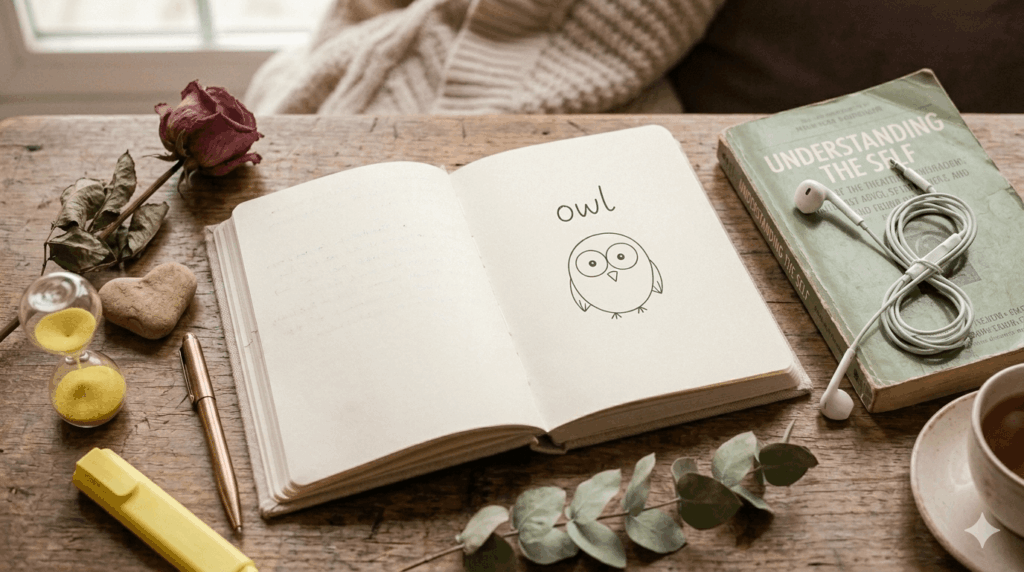
Jim Kwik categorises learners into types, and one of them is called the Owl.
The Owl is a deep processor. Owls take in information, go quiet, sit with it, turn it over. They don’t produce fast responses in real time. They need to sleep on things. Their insights often arrive late, in the car, in the shower, at 2am.
For years, I thought this was a weakness. Compared to people who can debate on their feet, who can fire back with smart observations mid-conversation, I felt like I was lagging.
But here’s what Jim Kwik says: Owls aren’t slow. They’re thorough. The depth of their processing is a strength, one that produces more nuanced, more considered, more durable thinking.
I’m not bad at thinking. I’m good at deep thinking. I just need to stop apologising for the time it takes.
I was convinced (or secretly hoped) I would be an elephant when I took the test… Hello, Owl brain. I see you now!
3. The Skill of Learning
Jim Kwik’s central argument is this: learning how to learn is the most important skill you can develop, and almost nobody teaches it.
We go through years of education where we’re taught what to think, but almost nothing about how to think. How to read actively. How to take notes that actually help your memory. How to study in a way that sticks rather than evaporates after the exam.
His techniques include:
- Spaced repetition: Reviewing material at increasing intervals to cement it into long-term memory
- Active recall: Testing yourself instead of just re-reading
- The memory palace: A visualisation technique for memorising lists, sequences, numbers
- Speed reading fundamentals: Reducing subvocalisation, using a finger as a guide to increase reading speed
- Chunking: Grouping information into meaningful patterns
I’ve been reading books for years and not doing most of this. I’d read, feel inspired, and then promptly forget 90% of it within a few weeks. Limitless is what made me start thinking that taking proper notes, which is part of why this blog exists, is not enough, I need to work with them.
How This Changed My Life
I’ve read over 60 self-development books in 5 years since 2021 (at the time of writing this, the number keeps going up). That’s not an accident. I read many more novels before that but never kept a log. Oh well, that part of my life is done. New phase, new me, it’s never too late to improve!
After reading Jim Kwik, I started reading actively, with a pen, underlining, writing in the margins and listening to the audiobook at the same time. I started photographing key passages and creating “deep dive” documents for the books that really hit me. I started taking notes not to look organised but because I now understand that writing something down is one of the most powerful memory tools we have.
The act of turning ideas into words, especially by hand, forces your brain to process them more deeply. You’re not just passively receiving information. You’re encoding it.
And I stopped being embarrassed about being an Owl. I stopped apologising for needing time to process. I started being curious about the depth of what I notice rather than trying to compete with the speed of others.
That shift, from “what’s wrong with me?” to “how does my brain work?”, has been quietly enormous.
What to Take From This
- Identify your learning lie: What do you tell yourself about your own intelligence? Write it down. Then ask: is this actually true, or is it a story I’ve been repeating?
- Find your learner type: Owl, Cheetah, Elephant, Parrot… look up Jim Kwik’s animal types. Knowing your type doesn’t limit you; it helps you work with yourself instead of against yourself.
- Take notes as you read: Not just highlights. Actually write down what something means to you, what question it raises, what you want to remember. Your future self will thank you.
- Use spaced repetition: Review your notes at 1 day, 1 week, 1 month. It sounds fiddly but the difference in retention is dramatic.
- Start speed reading with one tweak: Use your finger (or a pen) to guide your eyes as you read. It sounds silly; it works.
- Protect your brain in the morning: Jim Kwik talks a lot about the “digital invasion”, checking your phone first thing in the morning. Those first minutes of the day set the tone for your thinking. Guard them.
Related Notes from Soph
If this note on learning faster and remembering more helped, you might also like these connected Notes from Soph:
- Emotional Suppression and the Brain, for another Jim Kwik note on what blocks clear thinking.
- Use AI Without Losing Your Brain, for protecting thinking while using helpful tools.
- The Bullet Journal Method, for the external memory system that helped me think more clearly.
- How to Build Grit, for the consistency part of learning anything properly.
Why This Belongs in “Mind”
My blog is organised around my Tree of Life: Roots, Body, Mind, Heart, Soul, Purpose. Each section represents a part of my life that needs attention.
This belongs in Mind because it’s fundamentally about learning, about understanding how our brains work and how to use them more intentionally. Mind is where I put everything about books, podcasts, skills, and personal growth. And Limitless is the book that changed how I approach all of it.
If you’ve ever felt like a slow learner, like your memory is terrible, like everyone else’s brain works better than yours, please read this book. Not because Jim Kwik will give you superhuman memory in seven days. But because he’ll show you that the limits you think you have are mostly stories. And stories can be rewritten.
Et toi? What learning lie have you been telling yourself? Are you an Owl, a Cheetah, an Elephant or a Parrot? Come and share it in the Notes from Soph community on Skool, or leave a comment below. I would love to know.
Notes from Soph | Learning, not perfection.
Book Details
Limitless: Upgrade Your Brain, Learn Anything Faster, and Unlock Your Exceptional Life by Jim Kwik
Published 2020 | Hay House
ISBN: 9781401958237
📚 Amazon.co.uk Limitless by Jim Kwik
🎧 Audible.co.uk Search for Limitless by Jim Kwik on Audible
Disclosure: some links may be affiliate links. If you buy through one, I may earn a small commission at no extra cost to you. Thank you!

