Pierre-Emmanuel Branger: 3 Surprising Reasons His Performer Framework Is the Best Energy Reset
Pierre-Emmanuel Branger was not on my radar before this episode, which is probably why it worked on me. I had no expectations, no fan-girl energy and no resistance beyond my usual suspicion of anything branded as performance.
I found it before a commute to work, ready for something new for the drive ahead. I pressed play mostly to have something to listen to. I did not expect to go back to the transcript later, notebook open.
Pierre-Emmanuel Branger joined David Nicolas on Limitless Project to talk about what he calls Le Manuel du Performer, the performer’s manual. The title made me slightly suspicious. I have heard enough “high performance” content to last a lifetime, and most of it amounts to: wake up earlier, grind harder, sleep less.
This was nothing like that.
The important thing is that Pierre-Emmanuel Branger does not make performance sound like self-punishment. He talks about output, yes, but he keeps coming back to the state of the person producing that output. That matters to me. I have no interest in becoming more efficient if the cost is becoming more brittle.
As a teacher, I know this in my bones. A good lesson is not just the plan on paper. It is my energy in the room, my patience when a class gets noisy, my ability to adapt when something does not land and my recovery afterwards. If I arrive already depleted, the best plan in the world will not save me.
That made the whole framework feel less like productivity theatre and more like a grown-up conversation about capacity.
Table of Contents
Who Is Pierre-Emmanuel Branger?
Pierre-Emmanuel Branger is a French entrepreneur and coach who has built his work around one central insight: the bottleneck in most people’s performance is not time. It is energy.
You can have all the hours in the world and accomplish very little if you are running on empty. Conversely, a few focused hours with the right physical and mental state can produce more than an entire day of distracted busyness.
This reframe sounds obvious when you write it out. In practice, almost nobody is optimising for energy. We are all optimising for time, which is why most productivity advice leaves people feeling more overwhelmed rather than less.
Three Reasons This Framework Changes Everything
The first reason is that Pierre-Emmanuel Branger starts with biology, not willpower.
Your energy is not a fixed resource that you either have or lack, it is a renewable one, governed by rhythms that can be understood and worked with. Cortisol peaks in the morning. Focus follows biological cycles of roughly 90 minutes. Recovery is not optional; it is the condition for performance.
Most of us treat tiredness as a character flaw. He treats it as information. When you are exhausted, your system is telling you something about how you have been using your resources. The solution is not to push harder, it is to look more carefully at the design.
I connected this immediately to everything I have learnt about hormones, sleep and nutrition. When I started keto and my afternoon brain fog disappeared, it was not magic, it was my blood sugar stabilising, which is exactly the kind of biological input that shapes cognitive energy. Why We Sleep reinforced the same principle: the brain is not separate from the body. You cannot run on fumes and expect clarity.
The second reason is what Pierre-Emmanuel Branger says about morning routines, which is almost the opposite of what I expected.
He is not selling a rigid, 5am, ice-bath, meditation, gratitude-journaling, green-juice protocol. He is selling the concept of a morning that is intentionally yours before it belongs to anyone else.
The actual content matters less than the principle: the first hour (or two, or three, whatever you can protect) should not begin with other people’s priorities. No email. No school drop-off logistics. No crisis management. The morning is when cortisol is high and the mind is fresh, it is the worst time to spend reactive, and the best time to spend on the work that actually matters to you.
I thought about the years of school mornings, youngest can’t find his shoes, one of my teenage daughters in meltdown over a hairbrush, the other one behind a closed door. Every day beginning in someone else’s chaos. I had accepted this as the nature of things. Pierre-Emmanuel Branger made me realise it does not have to start that way.
The third reason is what he says about execution, which is the part most frameworks skip entirely.
Atomic Habits gives you the system. La Routine des Audacieux gives you the structure. Pierre-Emmanuel Branger gives you the process for actually doing the work once you sit down. Specifically: deciding the night before what the next day’s single most important output is. Not a list. One thing. The one that would make the day feel worthwhile even if nothing else happened.
This connects directly to GRIT, not the motivational version, but the practical one. Grit is not about intensity. It is about consistency of direction. You need to know, clearly, what you are consistently moving towards. Otherwise the energy has nowhere to go.
The Gentle Performance Version
What I am taking from Pierre-Emmanuel Branger is not a fantasy morning routine. It is the idea that my energy deserves to be designed around instead of exploited until it collapses.
For me, that means looking at the real week: teaching days, school runs, children, admin, writing, hormones, sleep, food and the fact that I am not a machine. Especially now that keto has changed my afternoon energy so dramatically, I can see how much biology matters. Stable blood sugar does more for my productivity than any colour-coded planner ever did.
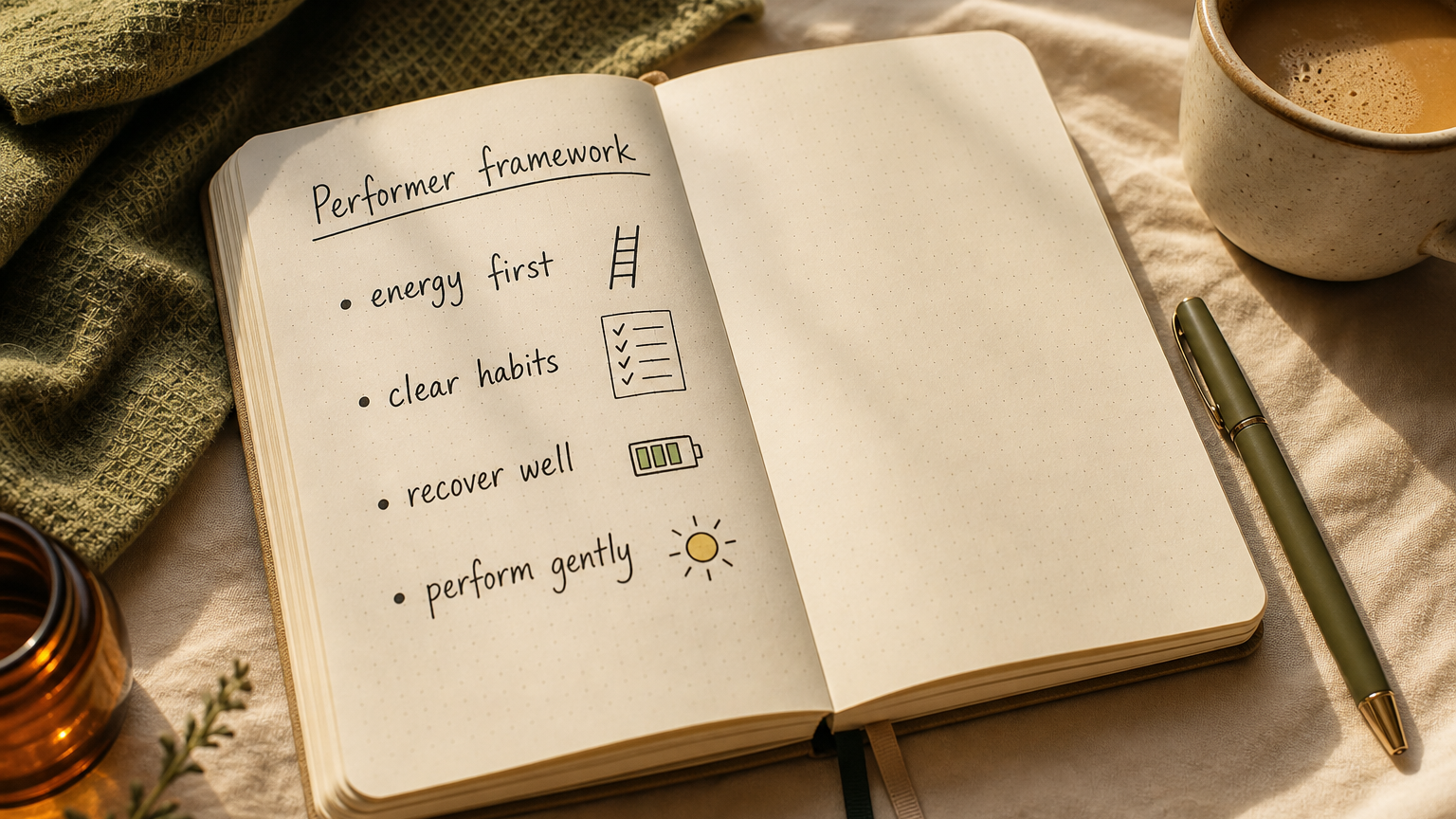
The phrase I wrote in my notebook was: perform gently. Not lazily. Not vaguely. Gently, as in with respect for the system doing the work. That feels like a Purpose post to me, because purposeful work is not just about doing more. It is about being able to keep doing what matters without burning the body that carries it.
Practical Takeaways
- Track energy, not time. For one week, note your energy level every two hours (1-10). Most people find clear patterns they had never noticed.
- Protect the first hour. Whatever time you wake up, make the first chunk yours before it becomes reactive. Even thirty minutes counts.
- Decide the night before. What is the one thing tomorrow that would make the day feel worthwhile? Write it down before you sleep. Your brain will start working on it overnight.
- Build micro-recovery into the day. A short walk, five minutes outside, a deliberate pause between tasks. Not luxury, biological necessity for sustained output.
- Design your worst-case day first. If the routine still works when everything goes wrong, it is a robust system. If it only works when conditions are perfect, it is a fantasy.
Why This Belongs in Purpose
Purpose, in my Tree of Life framework, is about the work I do in the world, teaching, creating, building something that matters. Pierre-Emmanuel Branger’s framework belongs here because it treats the capacity to do purposeful work as something worth designing carefully, not just hoping for.
Energy is not accidental. Neither is focus. Neither is the quality of the work I produce on any given day.
I am still working on the morning routine. It is harder than it sounds when you have three children and a teaching schedule that starts at 8h30. But I am working on it.
Notes from Soph | Learning, not perfection.
Et toi? Are you optimising for time or for energy? Come and share your current morning routine, good, bad, or completely chaotic, in the Notes from Soph community on Skool. I want to hear what actually works.
Source Details: Limitless Project, Épisode 153: “Le Manuel du Performer: Routines d’Énergie, Process d’Exécution” David Nicolas, feat. Pierre-Emmanuel Branger | 2026
🎙 Listen at limitlessproject.fr or search “Limitless Project” on Apple Podcasts / Spotify

