Stéphane Resimont: 3 Surprising Reasons Pleine Santé Is the Best Book for Functional Health
In April 2026, I drove to Toulon for a two full-day masterclass on the microbiome.
I know. Not everyone’s idea of a weekend out. But I had spent years getting blood results back from the GP with a cheery “everything is normal”, while feeling anything but. I wanted to understand what the numbers actually meant, which ones were worth caring about, and which tests my doctor was not even running.
I came home with pages of notes. And with this book.
Pleine Santé, Full Health, was written by Dr Stéphane Resimont, a Belgian doctor specialising in functional and anti-aging medicine, alongside Alain Andreu. I bought it at the seminar on impulse. It’s a beast but I finished it in two weeks!
I have been turning it over in my mind ever since.
Table of Contents
What Stéphane Resimont Means by Functional Medicine
The first thing Stéphane Resimont establishes, and the reason this is not just another nutrition book, is the difference between conventional medicine and functional medicine.
Conventional medicine waits for something to go wrong, then treats the symptom. Functional medicine asks: what are the conditions that allowed this to go wrong? It treats the cause, not the result. And crucially, it operates before illness becomes unavoidable.
He calls it the medicine of the four Ps: Personalised, Preventive, Predictive, Participative. That last one matters, it requires something from the patient. You cannot outsource your health entirely and expect functional medicine to work. You have to be willing to change things.
I am fundamentally suspicious of the mainstream medical system, some will say in a conspiracy way, but in a “I have seen what ‘normal’ looks like and I do not want it” way, I strongly believe our society is playing us. Stéphane Resimont’s approach resonated because it treats the patient as someone capable of understanding what is happening in their own body. Rare. Refreshing.
The Nine Causes of Ageing
This section of the book reorganised something I had been piecing together from many different sources. Stéphane Resimont identifies nine root causes of ageing and chronic illness:
Glycation, the process by which sugar reacts with protein to create damaged compounds called AGEs. The Maillard reaction, in other words: your body slowly caramelising. Every time blood sugar spikes, this process accelerates. Every time you eat ultra-processed food cooked at high temperature, you are adding to the load. Jessie Inchauspé’s Glucose Revolution covers the blood sugar piece in depth, Stéphane Resimont shows where glycation sits in the bigger picture.
Oxidation, the rust equivalent for biological tissue. Your body produces antioxidants (glutathion, coenzyme Q10, melatonin), but modern life outpaces the supply. Pollution, chronic stress, intense exercise without recovery, and overeating all increase oxidative load.
Chronic inflammation, the low-level, below-the-radar kind that standard blood tests rarely catch. Not the CRP your GP orders, the hs-CRP (highly sensitive CRP), which tells a completely different story. Paléobiotique goes into the gut-inflammation connection in detail; Stéphane Resimont connects it to ageing more broadly.
Telomere shortening, every time a cell divides, the protective caps at the ends of chromosomes get slightly shorter. When they run out, the cell stops dividing and the line dies. This is one of the core mechanisms of ageing, and it is influenced by lifestyle factors: stress, sleep, diet, exercise, supplementation.
Hormonal deficiencies, starting from age 25, not 50, like every blooming doctor, gynaecologist and midwife has been telling me in France! DHEA, testosterone, oestrogens, growth hormone, all begin declining well before we notice. The system of healthcare does not address this proactively because you cannot patent a natural molecule. Stéphane Resimont is clear-eyed about this, and I appreciated the honesty.
Plus epigenetic changes, DNA damage, immune loss, and mitochondrial decline, the mitochondria being the cellular energy factories that drop from roughly 100,000 per cell at 20 to 20,000 per cell at 40. If you ever wonder why your energy is not what it was, this is part of the answer.
The Gut Is Not a Tube
The second major shift this book created for me was in how I think about the gut.
I knew, intellectually, that the gut microbiome mattered. I had read Paléobiotique and Toxic Superfoods. But Stéphane Resimont puts together something I had not quite connected before: when the gut barrier is compromised, when leaky gut sets in, the blood-brain barrier becomes compromised too.
The intestine is not a passive tube. It contains 200 million neurons, communicates bidirectionally with the brain via the vagus nerve, and produces 90% of the body’s serotonin. Ninety per cent. The serotonin that conventional medicine tries to manipulate with antidepressants, the vast majority of it is produced in the gut, not the brain.
He makes the point that antidepressants are ineffective in the long run for 80% of patients, not because the patients are treatment-resistant, but because the medication is trying to recapture a neurotransmitter that is not there in the first place. The problem is not reuptake. The problem is production. And production lives in the gut.
This is the kind of thing I would have dismissed five years ago. Now it reads like common sense, because it connects to everything else I have been learning about nutrition, gut health and the gut-brain axis.
The ADHD Section
I need to mention this separately, because I read it three times.
Three of my children have ADHD diagnoses (which also means that my husband and I most probably also are!). I have spent the last two years immersed in the neurology, the medication protocols, the parenting approaches. Stéphane Resimont’s functional medicine take on ADHD is the clearest I have read.
He identifies possible contributing factors that conventional medicine rarely addresses: deficiencies in iron, zinc, magnesium, and omega-3. A compromised gut. Exposure to pollutants, pesticides, heavy metals. The presence of excessive sugar, food additives and food colourings in the diet.
He is not anti-medication. He documents the methylphenidate mechanism accurately. But he frames it as one tool among many, and makes the case that the underlying terrain, the gut, the micronutrient status, the inflammatory load, is what functional medicine should be addressing alongside or before medication.
I keep thinking about what I could have done differently, earlier. And then I remember that I could not have known what I did not know yet.
The Supplements You Actually Need
Stéphane Resimont cuts through the supplement noise with a clarity I found genuinely useful.
Three supplements he recommends for virtually everyone, without needing bloodwork to justify them:
Magnesium. Involved in nearly 600 enzymatic reactions in the body. Eighty per cent of the population is deficient, chronically. Stress accelerates the loss, when you are stressed, magnesium flushes out through the urine, which is why the first stage of burnout looks exactly like magnesium deficiency: anxiety, poor sleep, muscle tension, low motivation. He recommends 300-400mg daily in a well-absorbed form (bisglycinate, marine magnesium, glycerophosphate, not oxide, which passes straight through).
Vitamin D. Eighty per cent deficient in the general population, even in countries that get more sun than France. I live in Provence. I am still probably deficient. The implications reach from immune function to mood to cancer risk.
Omega-3. The anti-inflammatory fatty acids that the modern diet is almost entirely depleted of. Fish oil or krill oil, in meaningful doses, not the tiny capsule that gives you 300mg when you need several grams.
Everything else, he says, should follow from actual bloodwork. Not a hunch. Not marketing. Testing.
The 11 Fundamental Rules
Near the end of the book, Stéphane Resimont lists eleven rules for a healthy body. I wrote them all down.
Eat enough protein. Cut processed carbs. Favour good fats. Increase vegetables. Cook at low temperatures. Earn your carbohydrates with movement. Lift weights. Use a small plate. Chew properly. Sleep enough and get morning sunlight. Eat nuts, herbs, and spices.
Not groundbreaking individually. Together, they are a complete framework, and one that aligns exactly with what I have been building through keto, my gym practice, and everything I have learnt about nutrition over the past two years.
There is no turning back once you understand the mechanism. Once you know that gluten increases intestinal permeability and disrupts zonulin, you do not look at bread or pasta in quite the same way.
It baffles people around me. But once you embark on this kind of knowledge, there is no turning back. And the beauty of it all is that you do not miss it at all, because you look at society and how it manipulates us with a very critical eye and you finally see the truth amongst all the noise they create – consumerism, addictions, processed food dressed up as pleasure.
Once you understand what sugar does to your cells at a molecular level, the croissant looks different. Not moralistic. Biological. I am still learning and I am still cautious, but I would rather be cautious than ignore information my body has been asking me to understand.
The Part I Am Holding Carefully
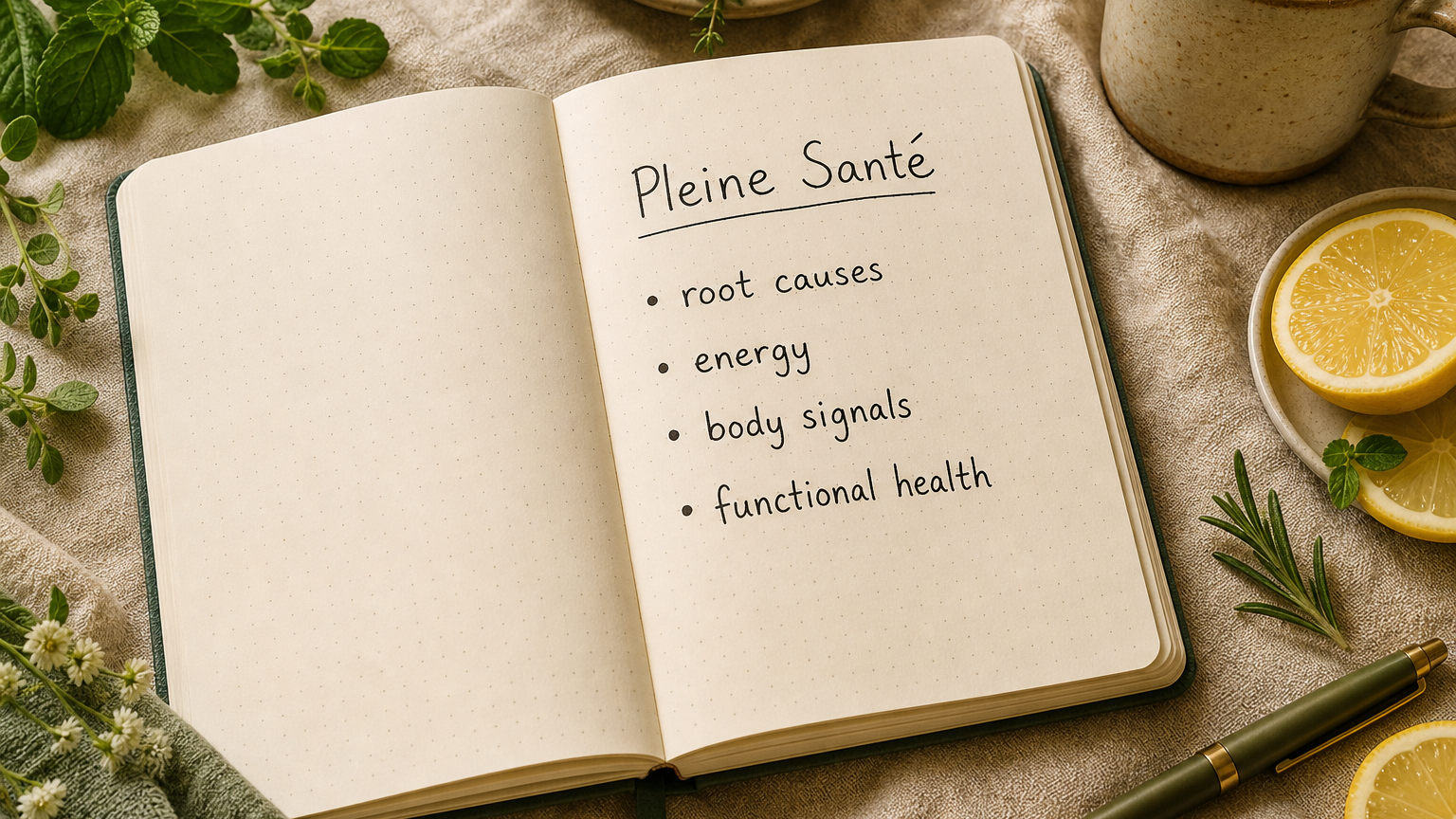
I want to be clear, because health writing can become bossy very quickly. I am not reading Stéphane Resimont as permission to diagnose myself, supplement wildly or treat every standard medical answer as useless. That is not what I want Notes from Soph to become.
What I am taking from him is a better set of questions. What is the terrain? What is the root cause? What is the marker that would show me this is improving? What am I assuming is normal because I have lived with it for so long?
This is especially important with keto. I experience strict keto as relief, not restriction, because my body is quieter on it. But I also know my microbiome and hormones need care, and I do not want to become another processed-keto consumer. Pleine Santé reminded me that health is not a label you wear. It is a set of conditions you keep tending to.
A quick health disclaimer before the practical bits: I am not a doctor, and this is not medical advice. These are my reading notes and personal reflections. Please speak to a qualified health professional before changing medication, supplements, diet or treatment, especially if you have a diagnosis, symptoms or children involved.
Practical Takeaways
- Get the right blood tests. Standard panels miss a great deal. Ask specifically for hs-CRP (high-sensitivity), homocysteine, vitamin D, ferritin, and a comprehensive thyroid panel (not just TSH). Hormone Repair Manual covers the female hormone piece; Stéphane Resimont covers everything else.
- Start with the three universals. Magnesium, vitamin D, and omega-3. Assume you are deficient in all three and supplement accordingly while you wait for bloodwork.
- Look after the gut first. Remove gluten and dairy if you suspect gut permeability. Add fermented foods (choucroute, kefir, kimchi), prebiotic fibre, and polyphenols. Give it six months. The microbiome changes slowly.
- Earn your carbohydrates. If you are not doing meaningful physical activity on a given day, carbohydrates are largely fuel you do not need. Adjust accordingly.
- Address the fundamentals before the supplements. Sleep, stress, gut health, movement, and blood sugar stability come first. No supplement will compensate for a lifestyle that is actively undermining your biology. La Routine des Audacieux and Why We Sleep are useful companions here.
Why This Belongs in Body
This book is in my Body section not because it is only about the physical, it very clearly is not. The gut-brain connection, the neurotransmitter production, the ADHD section, the hormonal influence on mood, all of it crosses into Mind and Heart territory.
But the starting point is always the body. Fix the terrain. Understand the biology. Create the conditions in which everything else becomes possible.
I am still working through the implications. Some of what Stéphane Resimont recommends requires a specialist, a functional medicine doctor who can actually run the right panels and interpret them properly. That costs more than a ten-minute GP appointment. It is also worth it in a completely different way.
Notes from Soph | Learning, not perfection.
Et toi? Have you ever asked for a blood test and been told “everything is fine” when something clearly was not? Come and share your experience in the Notes from Soph community on Skool, I would love to know I am not alone in this.
Book Details:
Pleine Santé – Dr Stéphane Resimont & Alain Andreu
Published 2020 | Éditions Mosaïque-Santé
📚 Amazon https://amzn.to/3RUJkh4
Disclosure: affiliate link, if you buy through this, I earn a small commission at no extra cost to you. Thank you!

